Showing posts with label events. Show all posts

Monday, October 1, 2018

Blabberque at Sugar Space

A band of artists from BBQLA rode through Indianapolis on the last leg of their Fool's Journey, a migrating yearlong exhibition.
The show, staged at Sugar Space, was accompanied by a performance dinner informally referred to as Blabberque IN.
Borrowing from the concept of the Jeffersonian Dinner, the performance assembled eight artists to parse a term of art jargon in whatever medium they saw fit.
The event lifted two main aspects from the Jeffersonian formula-- uniting deliberately selected guests invested in a common mission, and holding the floor for presentation on a single topic at a time.


As moderator, I (Erin K Drew) introduced the concept by acknowledging Thomas Jefferson's fucked legacy as imperialist slave owner, and stating an intention to downplay his contributions to the evening. I conducted the night dressed as a more benign Jefferson-- a Jefferson Airplane. Operating under the maxim that If You're Not Uncomfortable You're Not Doing Performance Art, I attempted to enjoy a slaw dog prepared by guest chef, artist Tre Reising, and multiple glasses of wine.


Presentations were given by:
Matthew Batty on Transcendence
Lisa Berlin Jackson on Problematic
A Bowden on Actuality
Bryn Jackson on Institutional Critique
Anna Martinez on Built Environment
Ben Martinkus on Appropriation
Breanne Trammel on Casual Institutions


Performance mediums ran the gamut from slideshow to sound performance, publication + Q&A (Martinez) to play (Martinkus).
Trammel distributed certificates of casual authenticity, inviting participants to forge credentials for their own areas of expertise.


Bryn Jackson, an IMA employee, acknowledged the tension of his role in absentia; a tv set stand-in sped through his selfies taken with the contemporary collection. While Berlin Jackson recited a nursery rhyme recounting fraught dynamics at the 2018 Whitney Biennial ("Dana Schutz for solemn thrill/appropriating Mamie Till") and beyond, Bowden confronted BBQLA's own problematic past, performing a text that referenced artistic intruders with "good intentions."

"I like to take a walk after dinner," Matthew Batty stated before leading participants on a meandering walk around the neighborhood. Strapped with a small amplifier which blasted mysterious audio into the dark, Batty tested a trio of places to lean an aluminum ladder before resting it in a patch of the Sugar Space garden bed.


Saturday, January 6, 2018

Putty Online

It has been sweet of you to literally hold your breath for months but you don't have to any more because every episode of Putty, my live art talk show, is now ONLINE and I am growing concerned for your health.

*Exhale*
...........
In your viewing adventures you may some things and people that look like this:


-Anne Laker led us through a Mad Lib in October!

-Likeable Local Man Michael Runge joined me for our Cultural Calendar "What'll We Do???" for 4 of 5 episodes before being savagely and unexpectedly replaced by Duncan Kissinger! (spot the difference!)

-In November I had brutal period cramps and was basically a folk hero for just being there!

-Brian James Priest announced plans to build an abortion clinic in his home in December!
-We played an art-generating game and A. Bowden maybe won!

-My level of alcohol consumption had dynamic effects on each episode's pacing! (unpictured)
-And MORE!

******
Season 2 starts in April; this will have to tide you over for now.

Sunday, September 24, 2017

Putty Progress


Putty, a live art chat show, PROCEEDS- establishing precedents, consuming and metabolizing the restless creative influence of its guests and audience members, and coagulating into something greater than the sum of its stylish parts.

Last episode shed light on the curatorial philosophies of IMOCA's executive director Paula Katz, let the B-town beat...mm drop with the poets of Monster House Press, illuminated Anna Martinez's aesthetic and spiritual debts to Catholicism and Pinterest, and connected lines between Mike "Process my Office" Moskaliuk's modular knob twiddling and stone carving personae (hint: it's texture and presence).


It was an evening of material and materiality, rooted in the staggeringly literal (house rule- no metpahors).
Also there were games, an Object Report, and an existential cultural calendar called WHAT'LL WE DO?? with man on the street Michael Runge.


The next episode, Wednesday, October 4, will feature interviews with poet, provocateur and daily diarist Anne Laker, video artist and grad school denier Nick Witten, an exit interview with curatorial duo A\M, and music by Casey No of Spandrels, all housed within the confines of State Street Pub, the Midwest's emerging destination for postdramatic theater. Doors at 7pm, show at 7:30, $2 admission.

Thursday, August 17, 2017

PUTTY

I've embarked on a new series.
PUTTY is a live art interview programme that appropriates and distorts the chat show medium.


Putty pulls its inspiration from the qualities of two materials:

Museum Putty--a utilitarian substance, defined by its relationship to the institution it supports.
-adheres art objects to pedestals, props them up but is rarely visible.
-is malleable, ready to use, and works on almost any surface, occupying a low role in high art.


Silly Putty--a novelty product without a clear function that bounces off and sticks across surfaces.
-pilfers Marmaduke's image from the Sunday comics and stretches it into new pooch mutations.


Putty plans to stick together disparate bits of the Indianapolis art scene, connecting artists as it connects audiences, growing as it rolls.
It hopes to shift the focus to under-recognized members of the community, challenging creative misuse and different looking, curating fascinating aesthetic conversations through best case scenario bar chatter, gossip and games.

Episode one at State Street Pub featured Rad Wytch writer Bree Jo'Ann, interdisciplinary reality fiddler Carla Knopp, painter and punk historian Becky Wilson, and musical guest Hen.
It boasted a kitschy set designed by Cinnamon Rose and Jessica Dunn of Brain Twins and styling (of yrs truly) by Geraldine Lee's Vintage.


Episode two airs Wednesday, September 13 at 8PM and features IMOCA curator Paula Katz, avant-bland installation impresario Anna Martinez, Indiana poetry imprint Monster House Press and musical guest Process My Office.
I will be your host, gleefully facilitating conversation while exercising discrete aesthetic control--deciding who you look at and where and when and how.
I've prepared for this role my entire life!

Sunday, July 30, 2017

Detention


In April I had the opportunity to stage a solo show at Indiana University-Purdue University Indianapolis.
Detention explored my complicated relationship to art education as a student and teacher.
This piece of writing functioned as my artist statement.


Nobody told me I’d be the next Basquiat,
the next YBA,
the new Jeanette Hayes
smearing authenticity
and hip acumen across
any given art forum.
Teachers never told me I’d be a
bad boy impresario
ashing cigs in the paté,
smug in shades.
But nobody told me I’d be at the beckon call
of a dozen little children
pasting tissue paper onto
cardboard tacos,
streaks of Elmer’s glue across my thighs
when I show up to the grant application office
in the eleventh hour.
In Senior Seminar on
Practical Concerns
they should say
“Beware of your talents,”
instead of reading aloud from
The Hydrogen Jukebox,
underclassmen feeding back
with beatnik snaps,
outsider poses ossifying.
Maybe that’s the implicit lesson,
the unspoken compact,
the vulgar picture you have to paint yourself:
reallocating resources,
smuggling creative labor into your dayjob,
appropriating the services
of your vibrant young students
as I make my money
teaching art
while it takes away from
my time to make it,
spinning a cautionary tale
about contradiction
as it envelopes me.
In detention,
where I know I am
because I’m bad,
I crack a book:
a little “Skepticism About”
nestled inside
“The Power of Art.”


Saturday, September 3, 2016

Extreme Exit Strategies

Seven years deep, I'm determining ways to officially end Extreme Appearances.
This will likely manifest in a physical publication, long hinted at.
A piece of print to expunge the records. Not the coffee table book I once imagined, but a slim photocopied volume of greatest hits.

And hanging in the website's place, digital residue.
A list of search terms to redirect your way finding.
Did you mean

Extreme Ape Hangers

Extreme Apathy

Extreme Apricot

Extreme Apple Body

Extreme Appetite Suppressants

or

Clean to the Extreme/Appearances


13 Extremely Unfortunate Boner Appearances


Extreme Readers: This Man Proves that Love does not Depend on Appearances!


Wednesday, October 28, 2015

Spooky Recap of the Creepy CRL


The Cartoon Research Lab started with a senseless death. In the clumsy morning hours before the lab, in a fit of unrested scrubbing, I broke the beloved and essential coffee cambro, which had survived so much before.
This incident heightened the level of psychic violence behind my eyes. My brain was squatted by a rolling boil of metal splinters, sawdust, and fog that could not part.
Arguably, this was the perfect state in which to experience the SPOOKY EDITION of the CRL!

And the disorientation didn't stop there!
After allowing eager viewers to pile their little paper plates with quiche and partake of the English muffin Face Buffet (viewable on instagram, #cartoonreasearchlab), John Flannelly led us through the first section of our morning's media. His subject was Stupid Idiots Getting Hurt and Covered In Garbage, and it was impressively researched. It began with "Die Fly Die," a Beavis and Butthead short that defined the genre. In an unexpectedly fitting turn of events, this video was only available ripped to youtube on its side; Beavis and Butthead seemed to walk up the wall, tumbling over each other and landing upright as they pursued a fly with blunt objects and toxins, inflicting worlds of harm on one another.


As they wake in a noxious haze, covered in trash, we viewers were plunged headlong into their unbalanced garbagescape. Conceptual stuff!

Flannelly moved on to Pingu, an ambiguously Nordic claymation series starring a baby penguin. In this selection, Pingu refuses to eat a bowl of green slop garnished with a fish skeleton that his parent has prepared. Shocked by her child's obstinance, Pingu is forced to stay at the table til his soup is gone. Antics ensue as Pingu attempts to discretely dispose of his unwanted soup, which gets smellier with the passage of time.

Flannelly's final selection was a midcentury safety animation for the US Navy, warning of looming dangers at home and at sea. It stars an anthropomorphized loudspeaker box who watches in terror as sailor after sailor passes away at the fate of thoughtless acts, ranging from smoking while pouring gasoline to being crushed by falling rigging, before turning into ghosts and going to heaven.

After a break for cigs and swigs--and social media!--I "fired up" The Devil and Daniel Mouse, a 1979 animated special made by Nelvana, the off-kilter Canadaian parallel to Disney. It is a classic cautionary tale about a provincial mouse musician in a wimpy folk duo selling her soul to be a rock star.


Lagging momentum in the third act is largely eclipsed by lots of funky character design including a pervy pink devil in ruffles (B. L. Zebub) and a band with a leatherclad new wave bunny and beaver with a big Afro who plays drums with his tail.
While neither my most academic offering for CRL, nor my spookiest, I believe the subversive power of pleasure is aligned with the pagan undertones of All Hallow's Eve.

Cool genius Lisa Berlin made her CRL debut with a thoughtfully curated set inning on psychological horror--the monsters of the mind--the call coming from inside the house! She showed Salad Fingers episode 8, a selection rendered eerier with added historical context. Berlin noted the references to British WWII child refugees throughout the series, which amplified the bombed out look of Salad Fingers' lonely house and made the static on his transistor full of beans a little grimmer. This was followed by a brief clip from Adventure Time starring the Lemongrabs, a dysfunctional pair of playmates whose violent clash for control over the fate of their doll hit a little close to home.


She rounded this out with a weird Disney short, 1945's "Duck Pimples," wherein Donald is rattled by vivid tableaux of the violent stories he reads. I liked it when a gangster moll climbed into the back of a big tough guy's jacket to make a phone call.

Bethy Squires and Colin Jenkins co-hosted the last portion of our programming with a set called "Don't Think About It," unified by images they found disturbing as children. We watched Nickelodeon's Doug get trapped in a haunted house ride with a troubling glass floor, and we watched Homer Simpson interact with the brittle remains of his neighbors in a Simpsons Treehouse of Horror parody called the Homega Man. Squires explained the theory of abjection as it related to her childhood visit to Disney World. Then Jenkins led us through some bizarre Disney Halloween wraparounds starring comedic improvisation legend John Winters as an incompetent night watchman AND pumpkin head in a crystal ball. He concluded with a Disney short where Pluto is on trial in hell for the crime of chasing cats. This cartoon featured the day's second jury of the damned, this one consisting of an impartial assembly of a dozen black cats.


***
A call to creatures of the night!!
Still not able to make it to daytime screenings of the CRL?
The Cartoon Research Lab will make a rare late-night appearance at General Public Collective on Thursday, November 5 to accompany 16MM screenings by 3Ton Cinema on tour from everywhere!
https://www.facebook.com/events/1621879548064444/

see you there!!!!


Saturday, October 3, 2015

Cartoon Research Lab: Chicago Edition

On Saturday, September 26, CRL awoke to find itself in unfamiliar territory, surrounded by sleeping bags and oddly flattering light.
After drinking a few cups of coffee its sense of purpose emerged--to screen cartoons to the denizens of Chicago's Learning Machine, flanked by some of the city's finest cartoon practitioners and nimblest wits.
I, Erin K Drew, was the the hiccuping Country Cousin, blustering into the big city with embarrassing enthusiasm, a laptop and a dream to showcase my project. I started the morning's entertainment with a selection of mid-century cartoons portraying Modern Art and Modern Artists.


While modern artists famously integrated imagery from comic books and commerce into their paintings and sculptures, collapsing distinctions between forms, cartoons parodied the habits and habitats of the untamed creative types as savage, seductive Others.
Screened as appetizers before artsy foreign films, the animation of Norman McLaren introduced audiences of cinema to the abstract possibilities of the moving image. "Dots" (1940) is as minimalist as they come, black balls of various sizes drawn directly onto film, with a farty, funky soundtrack generated in a similar way. It was immediately succeeded by "The Critic" from 1963, a Mel Brooks production in which a skeptical character provides arm chair art criticism over a McClaren-esque animation. Brooks has reported that his ad libbed monologue was based on comments made by a mumbling elderly audience member at an actual McClaren screening.


"The fellow who made this, he must be over thirty if they let him do this kind of thing, right? Why does he waste his time with this? A fellow like that, he could probably drive a truck."
Brooks' character ultimately vocalizes the conceit shared by the apostles of the culture wars: that artists are trying to bewilder and swindle viewers.
With this stance in mind, we moved on to "I Don't Want to Spoil the Party," a 1965 short from the briefly-lived Beatles cartoon series. It begins with the Beatles touring a stuffy New York museum, bored by The Spirit of Spring and fleeing for a Greenwich Village party, despite stern leader John's warnings about the world of trouble they could find at these "disgraceful parties." After obtaining directions from some gender-confusing individuals, the Beatles (sans John) embark on the Artists' milieu. They have fun observing the filthy freaks and their wacky habits (yoga! poetry! skateboarding!) until John bursts in in apelike pursuit. In a musical montage that owes more to film of the sixties (Breakfast at Tiffany's disgraceful soiree comes to mind) than to the properties of animation, the Beatles evade him as they play amidst a Mondrian-minimalist grid decked in sunglasses and sombreros and watch the wild partygoers interact.
The toon ends with John slipping on a toy left out by a child-adult and declaring that he'd like to stay with the artists forever.
From this cartoon I based the interchangability of the terms "artist" and "beatnik." Amidst swigs of coffee, audiences received instructions on how to be a Beatnik from Bullwinkle's Mr. Know it All then ventured with Beany and Cecil on their journey to ensnare the Wildman of Wildsville, a trophy weirdo from a faraway land, for sport.


In this 1961 Bob Clampett cartoon, a boy and his giant sock dragon pursue the legendary Wildman, an expressive savage voiced by Lord Buckley who swings on vines and scats in various states of undress. Similar to the Beatles episode, Beany and Cecil are seduced by the unkempt ways of the Wildman's world and veer between outfitting the Wildman with a straight jacket and opting to stay with him in his garishly painted world.

Jenna Caravello led us through the next round of deftly chosen cartoons featuring fluid transitions and timelessness and showcasing the possibilities of animation at its limits.
She began with Georges Schwizgebel's "Jeu" from 2006, a hand drawn animation that mutates through vignettes of leisure activities at a lurching vantage, then stops and rewinds. This was followed by Tezuka Osamu's "Jumping," a 1984 animated short that situates the viewer as the actor making outrageous leaps from backyard to jungle to war torn urban scene and into the underworld before resetting where it began. She ended with "Cat Soup," a dazzling 2001 short film by Tatsuo Sato that centers nebulously around a bizarre journey taken by a big-eyed white cat in search of its sister's soul.


This memorable and moving short unified Caravello's theme about the pointlessness of time and geography in cartoons while provoking questions about the distancing effects of experiments in animation and audience engagement in narrative.

Attendants smoked cigarettes and had varying degrees of success with bathroom processes for eleven minutes, and then Max Morris screened a few of his favorite cartoons. These selections centered around the theme of abjection and showed hilarious and terrifying body transformations.
Morris picked up where Jenna left off, showing an intense and apocalyptic slice of Masaaki Yuasa's "Mind Game," (2004) in which a group of humans who have been lodging in the belly of a whale must make a frantic escape before the whale dies. While more directly narrative than "Cat Soup," this scene unsticks in linear time as the characters flash back to scenes from earlier in the film and to previous events in the their (fictional) lives, ultimately resetting at the first scene of the film. This scene encapsulates the grand scale of "Mind Game" as a project and depicts the humor and horror of inhabiting a mortal human body-- no big deal.


Morris moved on to the humor and horror borne of sexual desperation as portrayed in "Eveready Harton and Buried Treasure," a piece of 1920's pornography (touchingly) gifted by a team of animators to Winsor McCay. In it, our hero Eveready and his enormous boner gets into trouble while attempting to make it with a woman, a man, a donkey, and a cow, ultimately finding the cow to be the most gracious partner.
He concluded his set with "King Size Canary," a 1947 Tex Avery classic of substance abuse in which the dramaturgical triad of dog-cat-mouse is disrupted by a bottle of Jumbo Grow plant formula. A cat and mouse battle to diminish one another until their bloated bodies outsize the globe and they collapse into each another's arms in resignation.


CRL Chicago was a gratifying and special experience. Chicago scholars elevated the discourse of our important work and were fun and good looking. Our hosts worked hard to show us country mice the ropes in the big city without robbing us of our endearing provincial dopiness.

Set your sights to the next iteration of the Cartoon Research Lab-- the Spooky Edition!-- Saturday, October 24 at 11am at General Public Collective.
https://www.facebook.com/events/987508811271831/

Thursday, September 17, 2015

What were Difficult Women?


A few months ago I put together a little showcase to toast my old friend Jail Flanagan as she passed through town with her one-woman baroque no wave act, Forced into Femininity, accompanied by LA noise artists Dawn Raid and Some Pepper.
I approached the show as I have many-- hoping to create the illusion of my city as a feminist art utopia, even if it was only for a night. To pull off this con I called upon Hen, bootleg cheerleaders and purveyors of dance academy recital punk (The Only Band I Like), to round out the bill. Not finding any other immediately suitable acts, I solicited artist friends with interesting and challenging taste--Copy Culture. Taryn facilitated meetings for a group called Cream Team over the winter and wore cool handmade jewelry and liked the band Kleenex. Anna was a painter with a website called ihatepainters.com. and had awesome eyebrows.
Did they ever think about doing performance?


I titled the night Difficult Women-- a soft understatement, and made a Facebook event with a stunning picture from one of Jail's recent shows.
Within 24 hours 100+ people had RSVP'ed, an abnormal feat for a noise show.
Something had aligned just right, and this night of Difficult Women seemed to be resonating with certain Indianapolis residents.


The show went well. Copy Culture's video "Consolation Prize" was hilarious and brilliant, and Forced Into Femininity hosted a Q&A for viewers mid-performance.

When Berlin-based theatrical chanteuse Mary Ocher contacted me about setting up a show in Indy, I decided to make it a series.

Much has been written about the stark class divide in art, and in Indianapolis specifically.
So often there are the people who make art and then there are the people who consume in.
Artists make work for whomever is willing to pay them, often censoring their own vision, sacrificing spontaneity and criticality along the way. Meanwhile, peers expect them to give their own art away for free, "for exposure," or for the sake of the scene, ultimately cheapening the specialness of their expression or the hours devoted to it.
It's a sticky situation, a capitalist vicious circle and the crux of plenty of existential strife.
It seems to me deeply ethical that artists receive fair pay for the strange mental work they are uniquely suited to do, that makes living in a city richer, that makes the human experience more fascinating.
So
it was important to me that as an organizer and artist/advocate, I could meet and exceed Mary Ocher's touring guarantee. This was not something I could expect to do with the traditional "passed hat" of DIY basement shows, and as a working artist, I clearly couldn't do it on my own.
But it became essential to me that it happen.
I was bewitched by her rawness, her unusual humor, her stunning aesthetic presence. (After viewing her videos, Youtube suggested I watch vids by Kate Bush and Werner Herzog, putting a finer point on this intoxicating combination of favorite elements.)


Her show became a jumping off point for thinking about the vitality of enticing unusual artists, particularly women, non male, and queer performers to come to Indianapolis. There seemed to be a void of venues specifically suited for this type of act, gay bars mostly giving billing to high ticket drag queens, DIY shows still representing the interests of Bands with Songs (with occasional notable exceptions). Yet the people who came to the first Difficult Women show or saw the Mary Ocher videos we circulated on social media were inspired and excited for more. Maybe the project of creating a temporary feminist art utopia was more important and timely than I expected.

I was not alone in thinking and talking about these issues. Lisa Berlin of Hen and General Public Collective played a particularly integral role in cultivating this idea. My own membership at General Public Collective added to the urgency and possibility of this project. GPC was the perfect place for Difficult Women showcases-- more visible than a basement, but scrappier than a venue, modular and mutating based on which of the collective members was organizing an event. Its doors are kept open (at erratic and unposted hours) with pledges from the individual members, who pay for their use of the space, or pay because they recognize the importance of the project.

Taking a page from this unusual manual for underwriting, Lisa and I looked for ways to make sure we could meet Mary's guarantee.
Naturally, we started puff painting sports bras.


I'd worked with this material in the past (as a pre-adolescent and beyond) and found it hilariously sloppy but also versatile and gratifying. We set to work with Aimee Brown (the other half of Hen), decorating bras and tote bags with images of phallic objects in peril and icons of Difficulty, like Miss Piggy, Patty and Selma from the Simpsons, Dolly Parton, and Divine.


Our efforts culminated in a photo shoot employing the talents of some of Indianapolis' most active badasses and restless intellects. Rachel Enneking wielded the camera and coached us through the shoot. Jessica Dunn of Brain Twins edited the photos and worked magic behind the scenes, even with a fucked up foot. Cinnamon Coleman, Joey Morrow, Abby Goldsmith, Rachel Peacock, Lisa Berlin and I donned power suits, fruit hats, and body paint and channeled the spirits of Difficult Women past-- John Waters' Provincetown group, Amy Sedaris, Tom Rubnitz's "Pickle Surprise" video (starring a young Rupaul and Lady Bunny), and Cindy Sherman's creepy later oeuvre were all on my vision board.


We premiered our photos and garments at a one night pop-up show at GPC. Garment displays for the show were assembled by Copy Culture--Anna and Taryn, who have both moonlighted in apparel merchandising and have amassed for their own artistic pursuits an array of sheets of colored plexiglass, mannequins in many textures, and mirrors. As our final touch, Taryn, Anna, Lisa, and I obscured the looming leftover graffiti mural from a previous pop-up with giant headless women, T.rexes with genitalia, shoes, and boobs. An enormous stylized vagina was exposed to Virigina Avenue passers-by but for a boudoir-style curtain hung in the front window.


The opening was well attended and we sold out of tote bags in the first couple hours. DJ Miss Alicia played electro pop singles to strut to and I ate a couple croissants. We were able to raise Mary Ocher's guarantee and create a buzz about our project. Nobody's parents came and I didn't have to talk to any local alt-weekly art critics about the vagina or give a broad operational definition of feminism so the night was full of successes, mostly on account of the pure collaboration that it had become.


Mary Ocher played at General Public Collective on Sunday, September 13 with Hen, a new video from Copy Culture, and a trio of videos from Bad Psychic-- Liv Mershon's Bloomington-based lofi goth project. The shop was packed with difficult women of various genders from near and far, and kind of had that feminist utopia vibe.


This project is not over.
Expect more Difficult Women showcases and pop-up shops in the future as we fund our endeavors through this ongoing experiment.
An altered incarnation of our pop up will be happening in Chicago at The Egg on Saturday, September 26!
https://www.facebook.com/events/1589592261301699/

Sunday, July 5, 2015

Cartoon Research Laboratory Recap

In the grim mid-morning hours of a Saturday in June, a dozen dedicated scholars in varying degrees of chemical disrepair met to attempt important work: deconstructing funny cartoons.
Cartoon practitioner/Rocket 88 baker Emily Gable greased the wheels of our investigation by providing an ample spread of lovingly-crafted blueberry donut holes. Blackberry yogurt in shortcake cups was available to soothe hungover tummies and a vast vat of coffee was offered to quiet the mind.


Aimee Brown led our investigation with a series of animated shorts teasing out the distinctions between cityfolk and country bumpkins. Refined hounds in monocles and wedding wear escorted their backwoods kin through the glossy smorgasbord of sensory delights that is The City. Unlikeable hillperson Snuffy Smith squared off with equally unlikeable, business savvy counterpart Barney Google. At least one academic present at the event overidentified with the champagne drunk faux pas of the Country Mouse in Silly Symphonies' "Country Cousin." And the legendary corrupting affects of urban life on a simple couple in love were played out in the grotesque and tidy melodrama of the Tex Avery-directed Warner Brother short "The Hick Chick."

Although this portion of the program was beset by some internet connectivity issues, buffering periods facilitated longer periods for productive discussion.

Economics is common sense made difficult. To decode its finer points, I turned to cartoons.
My first selection "We're in the Money" featured Warner Brothers' most feckless protagonist, Bosko, a humanimal of indeterminate taxonomy. It also reflected one of my favorite cartoon tropes: Night in the Store. "We're in the Money" dares to dream that when the doors are locked and the lights are out, objects in a department store can truly live. Disembodied overcoats wiggle away aside empty, animate oxfords. Gems under glass spin and genuflect in the jewelry case's reflective light.
This cartoon, like most of its kind, is light on plot--the way I prefer my media. But it also alludes to issues of materiality. Objects have agency. Faces on coins plead to be spent. And the frantic title tune reminds the listener that the success of an economy is contingent on keeping currency "rolling along."

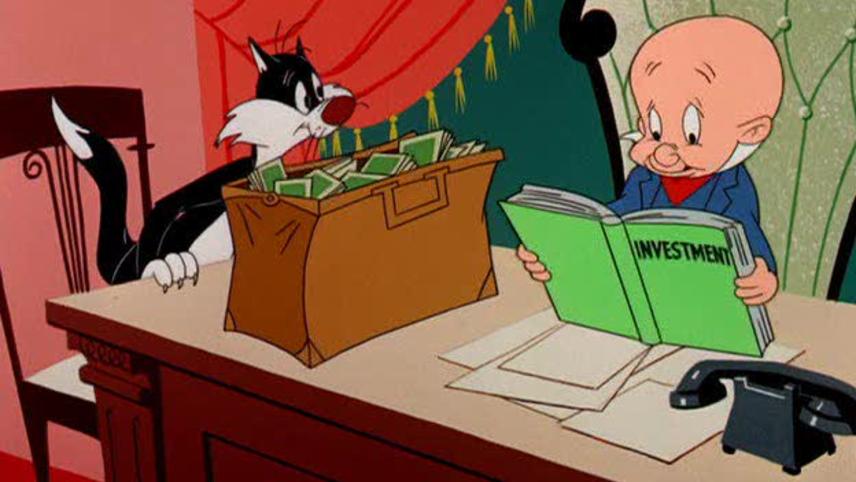
"Heir Conditioned" was one of three Warner Brothers shorts commissioned around 1955 by the Alfred P. Sloane Foundation to teach children about capitalism in the midst of the Cold War. This cartoon features some opportunistic trash cats eager to share Sylvester's newly inherited wealth. His economic advisor, Elmer Fudd, warns him against altruism and urges him to invest. After an unfun and didactic lesson, the trash cats get Stockholm Syndrome and refuse to accept Sylvester's handouts.

This set was rounded out with "Norman Normal," a bizarre late-period Warner Brothers' short of psychedelic nightmare capitalism. This existential tale of a salesman urged by his boss to take advantage of his client's drunken weakness at a kooky cinematic party doesn't seem to have been picked up as a recurring series. Perhaps 1968 TV execs passed on it due to confusion about the target demographic for animated psychological investigations.

Confusion about a cartoon's target audience was a theme which extended across the afternoon's offerings, most notably including "Po-Po-Tan," Bethy Squires' submission for this month's CRL.
This cartoon starts simply enough, when a young boy runs face first into a large pair of naked breasts.
Anime Review explains: "Beautiful sisters Ai, Mai, Mii, their android maid Mea and slippery pet ferret Unagi make an amazing journey together through time and space without ever leaving their beloved mansion behind! Following the clues of the strange dandelion-like “Popotan,” the girls are theoretically seeking the person who has the answers to their most personal questions, but they seem to have more than enough time to take side trips, meet new friends, visit hot springs and occasionally operate the X-mas shop they keep in the house along the way!"


The adult nature (upskirts, soft focus tits) of PoPoTan did seem to clash with the shrill child voices and sentimentality of the storyline.
"How am I supposed to jerk off to this?" posited Squires.

Few answers, more questions at this month's CRL.
Bring your theories and more topics for investigation to the table next time on Saturday, July 18 at 11AM at General Public Collective.
https://www.facebook.com/events/601278900014410/