Showing posts with label cartoons. Show all posts

Wednesday, October 28, 2015

Spooky Recap of the Creepy CRL


The Cartoon Research Lab started with a senseless death. In the clumsy morning hours before the lab, in a fit of unrested scrubbing, I broke the beloved and essential coffee cambro, which had survived so much before.
This incident heightened the level of psychic violence behind my eyes. My brain was squatted by a rolling boil of metal splinters, sawdust, and fog that could not part.
Arguably, this was the perfect state in which to experience the SPOOKY EDITION of the CRL!

And the disorientation didn't stop there!
After allowing eager viewers to pile their little paper plates with quiche and partake of the English muffin Face Buffet (viewable on instagram, #cartoonreasearchlab), John Flannelly led us through the first section of our morning's media. His subject was Stupid Idiots Getting Hurt and Covered In Garbage, and it was impressively researched. It began with "Die Fly Die," a Beavis and Butthead short that defined the genre. In an unexpectedly fitting turn of events, this video was only available ripped to youtube on its side; Beavis and Butthead seemed to walk up the wall, tumbling over each other and landing upright as they pursued a fly with blunt objects and toxins, inflicting worlds of harm on one another.


As they wake in a noxious haze, covered in trash, we viewers were plunged headlong into their unbalanced garbagescape. Conceptual stuff!

Flannelly moved on to Pingu, an ambiguously Nordic claymation series starring a baby penguin. In this selection, Pingu refuses to eat a bowl of green slop garnished with a fish skeleton that his parent has prepared. Shocked by her child's obstinance, Pingu is forced to stay at the table til his soup is gone. Antics ensue as Pingu attempts to discretely dispose of his unwanted soup, which gets smellier with the passage of time.

Flannelly's final selection was a midcentury safety animation for the US Navy, warning of looming dangers at home and at sea. It stars an anthropomorphized loudspeaker box who watches in terror as sailor after sailor passes away at the fate of thoughtless acts, ranging from smoking while pouring gasoline to being crushed by falling rigging, before turning into ghosts and going to heaven.

After a break for cigs and swigs--and social media!--I "fired up" The Devil and Daniel Mouse, a 1979 animated special made by Nelvana, the off-kilter Canadaian parallel to Disney. It is a classic cautionary tale about a provincial mouse musician in a wimpy folk duo selling her soul to be a rock star.


Lagging momentum in the third act is largely eclipsed by lots of funky character design including a pervy pink devil in ruffles (B. L. Zebub) and a band with a leatherclad new wave bunny and beaver with a big Afro who plays drums with his tail.
While neither my most academic offering for CRL, nor my spookiest, I believe the subversive power of pleasure is aligned with the pagan undertones of All Hallow's Eve.

Cool genius Lisa Berlin made her CRL debut with a thoughtfully curated set inning on psychological horror--the monsters of the mind--the call coming from inside the house! She showed Salad Fingers episode 8, a selection rendered eerier with added historical context. Berlin noted the references to British WWII child refugees throughout the series, which amplified the bombed out look of Salad Fingers' lonely house and made the static on his transistor full of beans a little grimmer. This was followed by a brief clip from Adventure Time starring the Lemongrabs, a dysfunctional pair of playmates whose violent clash for control over the fate of their doll hit a little close to home.


She rounded this out with a weird Disney short, 1945's "Duck Pimples," wherein Donald is rattled by vivid tableaux of the violent stories he reads. I liked it when a gangster moll climbed into the back of a big tough guy's jacket to make a phone call.

Bethy Squires and Colin Jenkins co-hosted the last portion of our programming with a set called "Don't Think About It," unified by images they found disturbing as children. We watched Nickelodeon's Doug get trapped in a haunted house ride with a troubling glass floor, and we watched Homer Simpson interact with the brittle remains of his neighbors in a Simpsons Treehouse of Horror parody called the Homega Man. Squires explained the theory of abjection as it related to her childhood visit to Disney World. Then Jenkins led us through some bizarre Disney Halloween wraparounds starring comedic improvisation legend John Winters as an incompetent night watchman AND pumpkin head in a crystal ball. He concluded with a Disney short where Pluto is on trial in hell for the crime of chasing cats. This cartoon featured the day's second jury of the damned, this one consisting of an impartial assembly of a dozen black cats.


***
A call to creatures of the night!!
Still not able to make it to daytime screenings of the CRL?
The Cartoon Research Lab will make a rare late-night appearance at General Public Collective on Thursday, November 5 to accompany 16MM screenings by 3Ton Cinema on tour from everywhere!
https://www.facebook.com/events/1621879548064444/

see you there!!!!


Saturday, October 3, 2015

Cartoon Research Lab: Chicago Edition

On Saturday, September 26, CRL awoke to find itself in unfamiliar territory, surrounded by sleeping bags and oddly flattering light.
After drinking a few cups of coffee its sense of purpose emerged--to screen cartoons to the denizens of Chicago's Learning Machine, flanked by some of the city's finest cartoon practitioners and nimblest wits.
I, Erin K Drew, was the the hiccuping Country Cousin, blustering into the big city with embarrassing enthusiasm, a laptop and a dream to showcase my project. I started the morning's entertainment with a selection of mid-century cartoons portraying Modern Art and Modern Artists.


While modern artists famously integrated imagery from comic books and commerce into their paintings and sculptures, collapsing distinctions between forms, cartoons parodied the habits and habitats of the untamed creative types as savage, seductive Others.
Screened as appetizers before artsy foreign films, the animation of Norman McLaren introduced audiences of cinema to the abstract possibilities of the moving image. "Dots" (1940) is as minimalist as they come, black balls of various sizes drawn directly onto film, with a farty, funky soundtrack generated in a similar way. It was immediately succeeded by "The Critic" from 1963, a Mel Brooks production in which a skeptical character provides arm chair art criticism over a McClaren-esque animation. Brooks has reported that his ad libbed monologue was based on comments made by a mumbling elderly audience member at an actual McClaren screening.


"The fellow who made this, he must be over thirty if they let him do this kind of thing, right? Why does he waste his time with this? A fellow like that, he could probably drive a truck."
Brooks' character ultimately vocalizes the conceit shared by the apostles of the culture wars: that artists are trying to bewilder and swindle viewers.
With this stance in mind, we moved on to "I Don't Want to Spoil the Party," a 1965 short from the briefly-lived Beatles cartoon series. It begins with the Beatles touring a stuffy New York museum, bored by The Spirit of Spring and fleeing for a Greenwich Village party, despite stern leader John's warnings about the world of trouble they could find at these "disgraceful parties." After obtaining directions from some gender-confusing individuals, the Beatles (sans John) embark on the Artists' milieu. They have fun observing the filthy freaks and their wacky habits (yoga! poetry! skateboarding!) until John bursts in in apelike pursuit. In a musical montage that owes more to film of the sixties (Breakfast at Tiffany's disgraceful soiree comes to mind) than to the properties of animation, the Beatles evade him as they play amidst a Mondrian-minimalist grid decked in sunglasses and sombreros and watch the wild partygoers interact.
The toon ends with John slipping on a toy left out by a child-adult and declaring that he'd like to stay with the artists forever.
From this cartoon I based the interchangability of the terms "artist" and "beatnik." Amidst swigs of coffee, audiences received instructions on how to be a Beatnik from Bullwinkle's Mr. Know it All then ventured with Beany and Cecil on their journey to ensnare the Wildman of Wildsville, a trophy weirdo from a faraway land, for sport.


In this 1961 Bob Clampett cartoon, a boy and his giant sock dragon pursue the legendary Wildman, an expressive savage voiced by Lord Buckley who swings on vines and scats in various states of undress. Similar to the Beatles episode, Beany and Cecil are seduced by the unkempt ways of the Wildman's world and veer between outfitting the Wildman with a straight jacket and opting to stay with him in his garishly painted world.

Jenna Caravello led us through the next round of deftly chosen cartoons featuring fluid transitions and timelessness and showcasing the possibilities of animation at its limits.
She began with Georges Schwizgebel's "Jeu" from 2006, a hand drawn animation that mutates through vignettes of leisure activities at a lurching vantage, then stops and rewinds. This was followed by Tezuka Osamu's "Jumping," a 1984 animated short that situates the viewer as the actor making outrageous leaps from backyard to jungle to war torn urban scene and into the underworld before resetting where it began. She ended with "Cat Soup," a dazzling 2001 short film by Tatsuo Sato that centers nebulously around a bizarre journey taken by a big-eyed white cat in search of its sister's soul.


This memorable and moving short unified Caravello's theme about the pointlessness of time and geography in cartoons while provoking questions about the distancing effects of experiments in animation and audience engagement in narrative.

Attendants smoked cigarettes and had varying degrees of success with bathroom processes for eleven minutes, and then Max Morris screened a few of his favorite cartoons. These selections centered around the theme of abjection and showed hilarious and terrifying body transformations.
Morris picked up where Jenna left off, showing an intense and apocalyptic slice of Masaaki Yuasa's "Mind Game," (2004) in which a group of humans who have been lodging in the belly of a whale must make a frantic escape before the whale dies. While more directly narrative than "Cat Soup," this scene unsticks in linear time as the characters flash back to scenes from earlier in the film and to previous events in the their (fictional) lives, ultimately resetting at the first scene of the film. This scene encapsulates the grand scale of "Mind Game" as a project and depicts the humor and horror of inhabiting a mortal human body-- no big deal.


Morris moved on to the humor and horror borne of sexual desperation as portrayed in "Eveready Harton and Buried Treasure," a piece of 1920's pornography (touchingly) gifted by a team of animators to Winsor McCay. In it, our hero Eveready and his enormous boner gets into trouble while attempting to make it with a woman, a man, a donkey, and a cow, ultimately finding the cow to be the most gracious partner.
He concluded his set with "King Size Canary," a 1947 Tex Avery classic of substance abuse in which the dramaturgical triad of dog-cat-mouse is disrupted by a bottle of Jumbo Grow plant formula. A cat and mouse battle to diminish one another until their bloated bodies outsize the globe and they collapse into each another's arms in resignation.


CRL Chicago was a gratifying and special experience. Chicago scholars elevated the discourse of our important work and were fun and good looking. Our hosts worked hard to show us country mice the ropes in the big city without robbing us of our endearing provincial dopiness.

Set your sights to the next iteration of the Cartoon Research Lab-- the Spooky Edition!-- Saturday, October 24 at 11am at General Public Collective.
https://www.facebook.com/events/987508811271831/

Sunday, July 5, 2015

Cartoon Research Laboratory Recap

In the grim mid-morning hours of a Saturday in June, a dozen dedicated scholars in varying degrees of chemical disrepair met to attempt important work: deconstructing funny cartoons.
Cartoon practitioner/Rocket 88 baker Emily Gable greased the wheels of our investigation by providing an ample spread of lovingly-crafted blueberry donut holes. Blackberry yogurt in shortcake cups was available to soothe hungover tummies and a vast vat of coffee was offered to quiet the mind.


Aimee Brown led our investigation with a series of animated shorts teasing out the distinctions between cityfolk and country bumpkins. Refined hounds in monocles and wedding wear escorted their backwoods kin through the glossy smorgasbord of sensory delights that is The City. Unlikeable hillperson Snuffy Smith squared off with equally unlikeable, business savvy counterpart Barney Google. At least one academic present at the event overidentified with the champagne drunk faux pas of the Country Mouse in Silly Symphonies' "Country Cousin." And the legendary corrupting affects of urban life on a simple couple in love were played out in the grotesque and tidy melodrama of the Tex Avery-directed Warner Brother short "The Hick Chick."

Although this portion of the program was beset by some internet connectivity issues, buffering periods facilitated longer periods for productive discussion.

Economics is common sense made difficult. To decode its finer points, I turned to cartoons.
My first selection "We're in the Money" featured Warner Brothers' most feckless protagonist, Bosko, a humanimal of indeterminate taxonomy. It also reflected one of my favorite cartoon tropes: Night in the Store. "We're in the Money" dares to dream that when the doors are locked and the lights are out, objects in a department store can truly live. Disembodied overcoats wiggle away aside empty, animate oxfords. Gems under glass spin and genuflect in the jewelry case's reflective light.
This cartoon, like most of its kind, is light on plot--the way I prefer my media. But it also alludes to issues of materiality. Objects have agency. Faces on coins plead to be spent. And the frantic title tune reminds the listener that the success of an economy is contingent on keeping currency "rolling along."

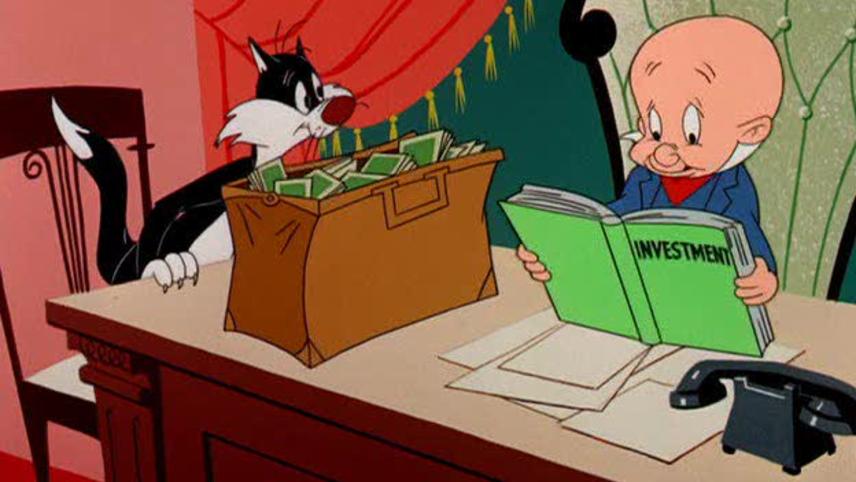
"Heir Conditioned" was one of three Warner Brothers shorts commissioned around 1955 by the Alfred P. Sloane Foundation to teach children about capitalism in the midst of the Cold War. This cartoon features some opportunistic trash cats eager to share Sylvester's newly inherited wealth. His economic advisor, Elmer Fudd, warns him against altruism and urges him to invest. After an unfun and didactic lesson, the trash cats get Stockholm Syndrome and refuse to accept Sylvester's handouts.

This set was rounded out with "Norman Normal," a bizarre late-period Warner Brothers' short of psychedelic nightmare capitalism. This existential tale of a salesman urged by his boss to take advantage of his client's drunken weakness at a kooky cinematic party doesn't seem to have been picked up as a recurring series. Perhaps 1968 TV execs passed on it due to confusion about the target demographic for animated psychological investigations.

Confusion about a cartoon's target audience was a theme which extended across the afternoon's offerings, most notably including "Po-Po-Tan," Bethy Squires' submission for this month's CRL.
This cartoon starts simply enough, when a young boy runs face first into a large pair of naked breasts.
Anime Review explains: "Beautiful sisters Ai, Mai, Mii, their android maid Mea and slippery pet ferret Unagi make an amazing journey together through time and space without ever leaving their beloved mansion behind! Following the clues of the strange dandelion-like “Popotan,” the girls are theoretically seeking the person who has the answers to their most personal questions, but they seem to have more than enough time to take side trips, meet new friends, visit hot springs and occasionally operate the X-mas shop they keep in the house along the way!"


The adult nature (upskirts, soft focus tits) of PoPoTan did seem to clash with the shrill child voices and sentimentality of the storyline.
"How am I supposed to jerk off to this?" posited Squires.

Few answers, more questions at this month's CRL.
Bring your theories and more topics for investigation to the table next time on Saturday, July 18 at 11AM at General Public Collective.
https://www.facebook.com/events/601278900014410/


Wednesday, June 17, 2015

Summer of CRL


The Cartoon Research Lab splices onward.
June 20 will be the second public iteration of the Saturday morning screening room, and the bar is set high after the May edition at General Public Collective.
Garish pink pastries from Rocket 88 rounded out an ample breakfast spread alongside Tex Avery-inspired exploding eyeball yogurt parfaits, recontextualized sugar cereals, and fussy cheeses scavenged by city mice in residence.


Lab Rats saw to it that baseline coffee levels were met by all present so they could turn their energy toward higher concerns:
Cartoons!
Relevantly, the first theme examined was starvation. Marx Shoemaker curated a set of clips showing cartoon protagonists driven to strange psychological states from hunger. Each cartoon was interspersed with an animated commercial for bullshit 80's snacks (Cheetos, Dunkaroos) that amplified the noisy derangement of a dieting Pink Panther's hallucinations, Sylvester the Cat's neurotic smoking, and Donald Duck and Goofy's violent betrayals of one another in pursuit of food.


This blog's author handpicked a set circling around the theme of Nightmares starting with "Pigs is Pigs"-- a truly disturbing cautionary tale of a punished (and ultimately unremorseful) piglet with a memorable force-feeding scene paying homage to Modern Times.


This was followed by "Pudgy Picks a Fight," a waking nightmare to rival Crime and Punishment in which Betty Boop's dog is plunged into denial and despair after assaulting her mink stole. The set ended with "The Big Snooze," a chaotic short in which Bugs Bunny invades Elmer Fudd's dreams--smearing him with nightmare paint, forcing him into drag and trotting him in front of a gang of lusty wolves, and otherwise wreaking havoc.

Bree Gerard provided a welcome deviation from the running vintage theme with a block of weird contemporary animation. She screened spaced out and surreal cartoons with idiosyncratic timing (Paper Rad's "Alfie") and immersive future(?) worlds (Cartoon Hangover's "Manly"). Appropriately, one video was a selection from Childgod996, an indie video game with a rich fantasy world being developed by a Bloomington, IN resident.


Bethy Squires of Bloomington's Sitcom Theater fame finalized the event with the most specifically focused set. Her selections followed the recurrence of "ear horns" as comedic devices and culminated with a beautiful, nearly silent Warner Bros. short directed by Chuck Jones called "Now Hear This."

These antique hearing aids seem to have no real life referent other than as examples of antique technology in cartoons, making a bizarre closed set of information: cartoons reflecting cartoons while cartoons reflect a weirdo version of the world at large...
A heady topic that the Cartoon Research Lab is uniquely qualified to address.

Come join the next round of discussions:
Saturday, June 20
11am-2pm
at General Public Collective
1060 Virginia Ave
Indianapolis IN


Coffee and exciting snacks are available for donation.

Tuesday, April 7, 2015

Cartoon Research Laboratory

Winter was a time for tea and contemplation of the nuances of anime.
Now it's Spring. Birds are chirping, bears are bumping butts, and big dogs are bonking little dogs on the head with meaty fists. It's duck season! It's rabbit season! It's Research Season.


Cartoon Research Laboratory is an opportunity to consider the themes and tropes of "classic cartoons" alongside recent animation that has absorbed their influence.
April's theme was "Night in the Store."


Cartoon Research Lab is also an opportunity to enjoy Surrealist breakfast food and lots of coffee amongst other scholars of the medium.

(one scholar with his deviled quail eggs, "Little Devils")


(one serious academic)