Showing posts with label art. Show all posts

Wednesday, February 24, 2021

Jessica Sowls' Cold War Desert

 Shortly after moving to Las Vegas, I was driving down Boulder Highway when a sign caught my eye. I pulled over to take a picture of the neon placard outside The Library, a defunct strip club that featured not just “Girls Girls Girls” but “Gorgeous Librarians.” Like everyone new to the city, I’ve photographed plenty of decaying neon, but this sign seemed like it deserved a specific audience. I texted the image to Jessica Sowls, a friend and former coworker at the Herron School of Art Library, where she works as a collections specialist. 

Her reply surprised me; Jessica said she missed driving around that area. Via text, she revealed her storied past in the Southwest—Utah, California and the Mojave. As an artist in residence at the Center for Land Use Interpretation in Wendover, Utah she’d embarked on her first exploration of decommissioned military sites and nuclear silos around the area, which led to more work on the topic. The conversation piqued my curiosity about my new home, and it created an unexpected connection with a friend whose past projects were news to me. After reading more about the colorful history of the Atomic Desert and the artwork it has spawned, I was inspired to inquire more deeply into Jessica’s work. 

Which of your desert-centric explorations of decommissioned space did you propose to the Center for Land Use Interpretation? Did you develop the project specifically 

for the residency? Did these projects relate to photographic work you were already doing?


What I proposed and what I ended up doing were very different. My proposal was to continue working on a photo series I had been doing involving a model rocket with a tiny camera on it. This was 2001, way before GoPros, Google Earth, etc. It was a still camera that used 110 film, which produced tiny and very grainy negatives. The moment the rocket fell back to earth, the nose cone separated from the body and the shutter was released. I would launch the rocket and then at the moment it took its picture of the ground from 500 ft in the air (presumably with me in it), I would photograph it. The two photos, one from the rocket's perspective, and one from mine, were then displayed as diptychs. 
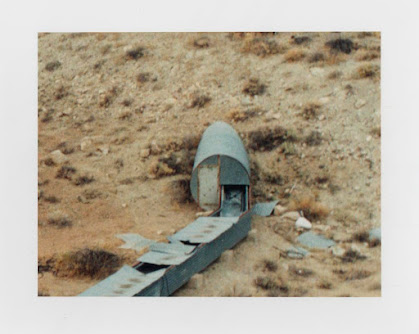


Jessica Sowls, Corrugated Tunnel from Reconnaissance series, 2007How did you find the sites you ended up photographing? What's your relationship to the American southwest, particularly those desert areas-- Utah and California? How did you start thinking about those spaces?

I was at the CLUI compound in Wendover for two months, with nothing to do but explore and read about the history of the region. They had published a book about interesting military and industrial sites in the region, fashioned as a travel guide. I spent a lot of time driving to all the sites, and became fascinated with these secretive places that were hiding in plain sight, with vague signs, many miles of fencing, and white SUVs that would appear out of nowhere when I got too close. There was a sense of foreboding everywhere. The residency housing is on a decommissioned army base, surrounded by abandoned barracks and right next to an enormous rusted airplane hangar. The base was built in WW2 and used as a top secret place to assemble the atomic bombs that were dropped on Japan and training the pilots that flew the missions. The rusty hangar was for the Enola Gay. 

This loaded atmosphere led me to want to do more "serious" work about the military. There was an interesting part of the old airfield on the base that had ruins of large ramps that were used to test the German V2 rockets that the US had confiscated during the war. At that point, these were the only rockets that had been invented, and the Americans were trying to reverse engineer their technology. So there I was, at the very spot the first rockets were launched on this continent. During this time I talked a lot with CLUI founder, Matt [Coolidge], who has an encyclopedic knowledge of the military industrial complex in the west, and he was suggesting other sites in the area. The next site in rocket history was not too far away, just a lone, unmarked, concrete bunker next to an asbestos disposal facility. It was there that the first missiles were launched. Rockets turned into missiles, and I just followed the trail, which took me to southern Utah, New Mexico, and Los Angeles. It was fascinating to learn about how the military evolved during the cold war, all while seeing changes happening in real time in response to 9/11. 

Jessica Sowls, Missile Project, 2002-4; The rusty ball on the floor is a gas tank for V2 rockets. Transparency film was displayed in 2x2” lightboxes.


Do you think there's something inherently "boy" to military/spy technologies?


It was not lost on me that my project was focused on a very phallic object. I thought of it as a distillation of the hypermasculinity of the military, wars, environmental destruction, etc. What better symbol of it all than a giant cock? Also I just liked how it all came back to this little model rocket I bought for fun. 

So I finished one series for the residency- photos of the missile launch sites and an accompanying booklet with the research I had done. I wanted to do more work in the area, so a few years later I came back to photograph the military sites from a different perspective. I was thinking more about what it felt like to be there while knowing what these innocuous looking ruins and giant swaths of fenced-off desert actually stood for. I pictured myself as a spy, decades too late to be of any use, futilely photographing cold war sites long after the cold war ended. My second project was a series based on that idea, grainy and washed out photos that looked a lot like the ones the model rocket took.


It's funny, the concept of being marooned at a residency with nothing to do but drive through desert sites and read about faded American history sounds so romantic, but quarantine has demonstrated that isolation can really drain creative focus.

What was the appeal of desert seclusion for you? What was the allure of the Southwest? As a Las Vegas resident, I'm trying to understand my own mystification of place--what drew me to move here. Did your time in LA [working at the Museum of Jurassic Technology] contribute to a sense of desert mystique?


I loved the work of Richard Misrach, and had absorbed messages about the freedom of the west from films like My Own Private Idaho and Paris Texas. The mystique is part of our culture- Easy Rider, Peewee’s Big Adventure, etc. When I first drove out to Utah from Minneapolis, I was amazed at how far I could see. A thunderstorm that looked to my midwestern eyes as if it were 10 minutes away was over an hour away. Everything was laid bare, all these military industrial sites were out in the open, you could drive around them and see everything (seemingly). It was as if a new way of seeing was shown to me. On all the dirt roads there were overturned rusted out cars shot full of bullet holes- so dramatic! The colors in the sky and the quality of light made photographs look better. 

As for ending up at CLUI, I just thought it looked interesting. And they paid residents $500/week, and I needed money and wanted to get out of the midwest. Simple as that. 

You’re right, isolation is so emotionally draining. And yet I’ve put myself in isolating situations many times because it feels familiar to me. It’s definitely one of my unhealthy reenactments of childhood.  

Jessica Sowls, Seneca Army Depot (Upstate New York), photograph, 2007


If you found yourself alone in the desert in 2020 what would you do now?


Alone in the desert now... it would be interesting to do a rephotographic survey in the style of Mark Klett. How have these military sites changed? Is accessing them more difficult in the age of terrorism? I spent most of my time out there in 2002-3, before much of the funding for stricter security actually went into effect. On a return visit in 2007ish, for the "Reconnaissance" series, things had changed a bit, but most places could still be accessed. 

I'd also like to expand a project I started when living in upstate NY, but never did anything with. I was working at the Cornell library, digitizing aerial photos of the entire state taken from an airplane in the 1960s. I became fascinated with the photos that showed the construction of interstate highways across the landscape, and the ones that showed the now abandoned Erie Canal. "Progress" in the making and discarded, both unnatural slashes across the landscape, like ancient earthworks. I saved the aerials, with GPS coordinates, and drove around photographing what they looked like now. If aerials like that exist in a western state, it could be a good compliment to that project.


Do any of the ways of working or insights that you developed during these projects influence your creative work now? Feel free to use this as an opportunity to contextualize what you're up to now.


My creative artwork now is barely existent. I discovered that I enjoyed being creative with food more than what the kind of work I was doing was inevitably turning into- a lot of time on the computer. The earlier projects were shot on film and printed in the darkroom. That method was becoming hard to access and digital means had replaced film. The exploring and shooting was still available to me, but I never wanted to do anything with the work after that. 

The biggest lesson I learned from the CLUI experience was the harder I tried to make something that encompassed everything I wanted to say, the more difficult it became to make anything at all. I was fresh out of art school, just 23, when I got the residency and an additional emerging artists grant. I wanted to prove myself so badly. My own perfectionism ruined my art career. 


Monday, May 11, 2020

Bunter


I don't know why, but this Tweet keeps coming true.

Wednesday, February 28, 2018

Monumental Publication Reissue

I've printed a new run of my book to commemorate a new professional setback!

Museum Putty is a compendium of lowlife odes to high institutions, David Byrne/Cindy Sherman erotic speculation, true tales of pain from Chicago's MCA and other instructive texts.


Please send 5 digital American dollar bills for the symbolic partial ownership of this important piece of literature to my Venmo account:
extremeappearances@gmail.com

Thank you and have a nice day.

Saturday, January 6, 2018

Putty Online

It has been sweet of you to literally hold your breath for months but you don't have to any more because every episode of Putty, my live art talk show, is now ONLINE and I am growing concerned for your health.

*Exhale*
...........
In your viewing adventures you may some things and people that look like this:


-Anne Laker led us through a Mad Lib in October!

-Likeable Local Man Michael Runge joined me for our Cultural Calendar "What'll We Do???" for 4 of 5 episodes before being savagely and unexpectedly replaced by Duncan Kissinger! (spot the difference!)

-In November I had brutal period cramps and was basically a folk hero for just being there!

-Brian James Priest announced plans to build an abortion clinic in his home in December!
-We played an art-generating game and A. Bowden maybe won!

-My level of alcohol consumption had dynamic effects on each episode's pacing! (unpictured)
-And MORE!

******
Season 2 starts in April; this will have to tide you over for now.

Sunday, September 24, 2017

Putty Progress


Putty, a live art chat show, PROCEEDS- establishing precedents, consuming and metabolizing the restless creative influence of its guests and audience members, and coagulating into something greater than the sum of its stylish parts.

Last episode shed light on the curatorial philosophies of IMOCA's executive director Paula Katz, let the B-town beat...mm drop with the poets of Monster House Press, illuminated Anna Martinez's aesthetic and spiritual debts to Catholicism and Pinterest, and connected lines between Mike "Process my Office" Moskaliuk's modular knob twiddling and stone carving personae (hint: it's texture and presence).


It was an evening of material and materiality, rooted in the staggeringly literal (house rule- no metpahors).
Also there were games, an Object Report, and an existential cultural calendar called WHAT'LL WE DO?? with man on the street Michael Runge.


The next episode, Wednesday, October 4, will feature interviews with poet, provocateur and daily diarist Anne Laker, video artist and grad school denier Nick Witten, an exit interview with curatorial duo A\M, and music by Casey No of Spandrels, all housed within the confines of State Street Pub, the Midwest's emerging destination for postdramatic theater. Doors at 7pm, show at 7:30, $2 admission.

Thursday, August 17, 2017

PUTTY

I've embarked on a new series.
PUTTY is a live art interview programme that appropriates and distorts the chat show medium.


Putty pulls its inspiration from the qualities of two materials:

Museum Putty--a utilitarian substance, defined by its relationship to the institution it supports.
-adheres art objects to pedestals, props them up but is rarely visible.
-is malleable, ready to use, and works on almost any surface, occupying a low role in high art.


Silly Putty--a novelty product without a clear function that bounces off and sticks across surfaces.
-pilfers Marmaduke's image from the Sunday comics and stretches it into new pooch mutations.


Putty plans to stick together disparate bits of the Indianapolis art scene, connecting artists as it connects audiences, growing as it rolls.
It hopes to shift the focus to under-recognized members of the community, challenging creative misuse and different looking, curating fascinating aesthetic conversations through best case scenario bar chatter, gossip and games.

Episode one at State Street Pub featured Rad Wytch writer Bree Jo'Ann, interdisciplinary reality fiddler Carla Knopp, painter and punk historian Becky Wilson, and musical guest Hen.
It boasted a kitschy set designed by Cinnamon Rose and Jessica Dunn of Brain Twins and styling (of yrs truly) by Geraldine Lee's Vintage.


Episode two airs Wednesday, September 13 at 8PM and features IMOCA curator Paula Katz, avant-bland installation impresario Anna Martinez, Indiana poetry imprint Monster House Press and musical guest Process My Office.
I will be your host, gleefully facilitating conversation while exercising discrete aesthetic control--deciding who you look at and where and when and how.
I've prepared for this role my entire life!

Sunday, July 30, 2017

Detention


In April I had the opportunity to stage a solo show at Indiana University-Purdue University Indianapolis.
Detention explored my complicated relationship to art education as a student and teacher.
This piece of writing functioned as my artist statement.


Nobody told me I’d be the next Basquiat,
the next YBA,
the new Jeanette Hayes
smearing authenticity
and hip acumen across
any given art forum.
Teachers never told me I’d be a
bad boy impresario
ashing cigs in the paté,
smug in shades.
But nobody told me I’d be at the beckon call
of a dozen little children
pasting tissue paper onto
cardboard tacos,
streaks of Elmer’s glue across my thighs
when I show up to the grant application office
in the eleventh hour.
In Senior Seminar on
Practical Concerns
they should say
“Beware of your talents,”
instead of reading aloud from
The Hydrogen Jukebox,
underclassmen feeding back
with beatnik snaps,
outsider poses ossifying.
Maybe that’s the implicit lesson,
the unspoken compact,
the vulgar picture you have to paint yourself:
reallocating resources,
smuggling creative labor into your dayjob,
appropriating the services
of your vibrant young students
as I make my money
teaching art
while it takes away from
my time to make it,
spinning a cautionary tale
about contradiction
as it envelopes me.
In detention,
where I know I am
because I’m bad,
I crack a book:
a little “Skepticism About”
nestled inside
“The Power of Art.”


Tuesday, July 25, 2017

Museum Pity

If it’s bad make it
big red and wrong
trippped over,
hangdog empathy
for the pedestals and benches.
The Artschwager sat upon.
The crowning kicked.
The sculptures cucked.
The platinum paintings
going down in da Hall of Mirrors
refract, refract:
a Bruce Nauman two step-


the unfunnest club
My friend guarded
speed dating in the contemporary wing
when a horny patron cut her shin
on the Patty Chang.
Blood on her radio she yelled
“I’m at the Chang!”
but no one came
cuz no one knew the artist’s name.
Guards staked a flag in skin
to signify
Real contempt for the Viewer.
A construction sign
says Pardon our Process.
Maybe the pieces don’t wanna
Get got.

Tuesday, August 23, 2016

Call for Monumental Anecdotes


Friends:
Some of you have spent many years in Indianapolis; others just a few significant weeks.
Regardless, I come to you in search of your experiences.

I have been asked to make artwork for the Harrison Center for the Arts Bicentennial celebration of the state of Indiana.
This group show will hinge on Monumentality and literally and figuratively be inspired by the Soldiers and Sailors Monument, the heavily adorned obelisk at the center of my non-mean city.

For this show, I plan to collect anecdotes from you about *monumental* experiences you have had in the vast and varied neighborhoods of Indianapolis.
I will represent your experiences in the form of fabric flags that simplify and symbolize events and blur lines between public and private history.
Ultimately, these anecdotal flag designs will be fabricated on a smaller scale and sold in the gift shop of the Soldiers and Sailors Monument itself.

What experiences count as MONUMENTAL?
I want to hear about your arguments, illnesses, and unexpected discoveries. I want tales of lust, tragedy, tragicomedy, dissociation and drunkenness.
I want to hear about the events that came to signify your experiences with specific districts of Indianpolis— from Broadripple to Fountain Sqaure, from Castelton to Englewood, to whatever happens on the westside.
If you do not know what to write, I am always interested in the conditions that produce public crying.

The artwork resulting from this project will be exhibited October 7-28 at the Harrison Center alongside a short statement culled from your testimonial.

Please limit your anecdotes to 500 words and specify the neighborhood in which your story occurred.
Submissions are needed by Thursday, September 1, 2016 and should be directed to extremeappearances@gmail.com

Your favorite flag waving Hoosier,
Erin K Drew

Thursday, December 17, 2015

Response to review of "Doing it Themselves: Artists Explore the Handmade"

I wrote this in response to the review of "Doing it Themselves: Artists Exploring the Handmade" by Dan Grossman, on view at the Indianapolis Art Center until January 30, 2016.

I want to respond to the point that my artwork “may not offer social commentary…if there is such a thing, beyond irreverence.”
As an instructor, I insist to my students that the primary job of an artist is to communicate—either by visualizing the ineffable, or by contributing to an onging cultural dialogue in a way that adds something to our understanding of the world.
It is her responsbility to know what she is trying to communicate before the viewer, loaded with his own experiences and influences, complicates the dialogue.

I am interested in investigating the distinctions between art, decoration, and kitsch and the function of adornment. I am fascinated by the utility of pictures, particularly the kind that are so commonplace as to be overlooked.
The piece referred to by Mr. Grossman, “Welcome” references a traditional household sign—a plaque or flag bearing a pineapple saying “Welcome,” or “Welcome Friends.”
While I’m aware of the history of pineapples as symbols for goodwill, I am more confused about the ubiquity of this kind of signage in homes or on the shelves of stores, where many people seem to purchase framed images.
What would be the affect if the artist adjusts the language?

I guess this could be referred to as a kind of irreverence, if you choose to hear me “taking a tone,” but I consider it part of an investigation into the function of marginal forms.
As I wrote in my statement for “Doing it Themselves,” I am equally fascinated with looking at the reflexively made art of neighborhood backyards and basement thrift stores as the art of galleries and museums. I relate to the imperfections of these forms and their immediacy.
Surprisingly, this gets into terrain about class and power.
The people who made the puffpainted sweatsuit or poured concrete lawn goose might have access to 3D printers and and wireless scanning but as a downwardly mobile artist in search of a sustainable practice, I do not. Or, more significantly, I choose to work with the materials to which I have more immediate access (paper, plywood, paint). In this case the medium is part of the message.
In this same way, choosing to learn from a small business’s hand painted signage or investigate the function of folk mediums could be an attempt at amplifying the marginal and destabilizing power, which is the thrust of my artmaking commentary. Sorry mom and Mr. Grossman, it’s not just a phase.


Friday, November 13, 2015

Hashtag #Pedagogy


My student took these hilariously unflattering photographs of me the other day "Oh Captain My Captain"-ing out on my last day of teaching art at Indiana Youth Group--Indy's queer teen drop-in clubhouse--this year.


In my defense, these pictures document the award ceremony from the end of our 12 week session, so there was occasion to be especially expressive.
Certificates were awarded in student-invented categories including "Cutest Baby Gaylien" and "Most Annoying Asexual." I officially signed off on all awards.


Our ceremony included speeches, picture-snapping paparazzi (obviously), and a Roast of the Instructor.

(This lesson also provided an excuse to purchase this vintage gag award I've had my eye on to use as a visual aid/vital teaching tool.)


This has been my favorite teaching experience to date.
At its (temporary) conclusion, I would sweep the category of saddest, loudest teacher.

Thursday, September 17, 2015

What were Difficult Women?


A few months ago I put together a little showcase to toast my old friend Jail Flanagan as she passed through town with her one-woman baroque no wave act, Forced into Femininity, accompanied by LA noise artists Dawn Raid and Some Pepper.
I approached the show as I have many-- hoping to create the illusion of my city as a feminist art utopia, even if it was only for a night. To pull off this con I called upon Hen, bootleg cheerleaders and purveyors of dance academy recital punk (The Only Band I Like), to round out the bill. Not finding any other immediately suitable acts, I solicited artist friends with interesting and challenging taste--Copy Culture. Taryn facilitated meetings for a group called Cream Team over the winter and wore cool handmade jewelry and liked the band Kleenex. Anna was a painter with a website called ihatepainters.com. and had awesome eyebrows.
Did they ever think about doing performance?


I titled the night Difficult Women-- a soft understatement, and made a Facebook event with a stunning picture from one of Jail's recent shows.
Within 24 hours 100+ people had RSVP'ed, an abnormal feat for a noise show.
Something had aligned just right, and this night of Difficult Women seemed to be resonating with certain Indianapolis residents.


The show went well. Copy Culture's video "Consolation Prize" was hilarious and brilliant, and Forced Into Femininity hosted a Q&A for viewers mid-performance.

When Berlin-based theatrical chanteuse Mary Ocher contacted me about setting up a show in Indy, I decided to make it a series.

Much has been written about the stark class divide in art, and in Indianapolis specifically.
So often there are the people who make art and then there are the people who consume in.
Artists make work for whomever is willing to pay them, often censoring their own vision, sacrificing spontaneity and criticality along the way. Meanwhile, peers expect them to give their own art away for free, "for exposure," or for the sake of the scene, ultimately cheapening the specialness of their expression or the hours devoted to it.
It's a sticky situation, a capitalist vicious circle and the crux of plenty of existential strife.
It seems to me deeply ethical that artists receive fair pay for the strange mental work they are uniquely suited to do, that makes living in a city richer, that makes the human experience more fascinating.
So
it was important to me that as an organizer and artist/advocate, I could meet and exceed Mary Ocher's touring guarantee. This was not something I could expect to do with the traditional "passed hat" of DIY basement shows, and as a working artist, I clearly couldn't do it on my own.
But it became essential to me that it happen.
I was bewitched by her rawness, her unusual humor, her stunning aesthetic presence. (After viewing her videos, Youtube suggested I watch vids by Kate Bush and Werner Herzog, putting a finer point on this intoxicating combination of favorite elements.)


Her show became a jumping off point for thinking about the vitality of enticing unusual artists, particularly women, non male, and queer performers to come to Indianapolis. There seemed to be a void of venues specifically suited for this type of act, gay bars mostly giving billing to high ticket drag queens, DIY shows still representing the interests of Bands with Songs (with occasional notable exceptions). Yet the people who came to the first Difficult Women show or saw the Mary Ocher videos we circulated on social media were inspired and excited for more. Maybe the project of creating a temporary feminist art utopia was more important and timely than I expected.

I was not alone in thinking and talking about these issues. Lisa Berlin of Hen and General Public Collective played a particularly integral role in cultivating this idea. My own membership at General Public Collective added to the urgency and possibility of this project. GPC was the perfect place for Difficult Women showcases-- more visible than a basement, but scrappier than a venue, modular and mutating based on which of the collective members was organizing an event. Its doors are kept open (at erratic and unposted hours) with pledges from the individual members, who pay for their use of the space, or pay because they recognize the importance of the project.

Taking a page from this unusual manual for underwriting, Lisa and I looked for ways to make sure we could meet Mary's guarantee.
Naturally, we started puff painting sports bras.


I'd worked with this material in the past (as a pre-adolescent and beyond) and found it hilariously sloppy but also versatile and gratifying. We set to work with Aimee Brown (the other half of Hen), decorating bras and tote bags with images of phallic objects in peril and icons of Difficulty, like Miss Piggy, Patty and Selma from the Simpsons, Dolly Parton, and Divine.


Our efforts culminated in a photo shoot employing the talents of some of Indianapolis' most active badasses and restless intellects. Rachel Enneking wielded the camera and coached us through the shoot. Jessica Dunn of Brain Twins edited the photos and worked magic behind the scenes, even with a fucked up foot. Cinnamon Coleman, Joey Morrow, Abby Goldsmith, Rachel Peacock, Lisa Berlin and I donned power suits, fruit hats, and body paint and channeled the spirits of Difficult Women past-- John Waters' Provincetown group, Amy Sedaris, Tom Rubnitz's "Pickle Surprise" video (starring a young Rupaul and Lady Bunny), and Cindy Sherman's creepy later oeuvre were all on my vision board.


We premiered our photos and garments at a one night pop-up show at GPC. Garment displays for the show were assembled by Copy Culture--Anna and Taryn, who have both moonlighted in apparel merchandising and have amassed for their own artistic pursuits an array of sheets of colored plexiglass, mannequins in many textures, and mirrors. As our final touch, Taryn, Anna, Lisa, and I obscured the looming leftover graffiti mural from a previous pop-up with giant headless women, T.rexes with genitalia, shoes, and boobs. An enormous stylized vagina was exposed to Virigina Avenue passers-by but for a boudoir-style curtain hung in the front window.


The opening was well attended and we sold out of tote bags in the first couple hours. DJ Miss Alicia played electro pop singles to strut to and I ate a couple croissants. We were able to raise Mary Ocher's guarantee and create a buzz about our project. Nobody's parents came and I didn't have to talk to any local alt-weekly art critics about the vagina or give a broad operational definition of feminism so the night was full of successes, mostly on account of the pure collaboration that it had become.


Mary Ocher played at General Public Collective on Sunday, September 13 with Hen, a new video from Copy Culture, and a trio of videos from Bad Psychic-- Liv Mershon's Bloomington-based lofi goth project. The shop was packed with difficult women of various genders from near and far, and kind of had that feminist utopia vibe.


This project is not over.
Expect more Difficult Women showcases and pop-up shops in the future as we fund our endeavors through this ongoing experiment.
An altered incarnation of our pop up will be happening in Chicago at The Egg on Saturday, September 26!
https://www.facebook.com/events/1589592261301699/

Saturday, July 12, 2014

Supplicant

The universe has created a situation in which I must cross a road choked with every cop car in the city to turn in an art grant application in the eleventh hour. I dash into traffic flanked by dads saluting as a hearse glides by on Delaware and I thought the word "pig" but said the words "fallen officer" to the well-dressed man from the art organization who recognized my Manila folder and frantic gait. I ignored some winky slacker inferences as I thrust the thing into administrative hands, who discerned a doping sub-adult in the business of spinning newsprint into ridiculous foody forms, smelled me troubleshooting for little children, contentedly pasting ice green tissue paper onto cardboard tacos at their beckon call. I am a lady in waiting to a little girl who paints a gargantuan Starbucks frappuccino pink with her entire palm and I have streaks of Elmer's school glue on my thighs when I show up to ask the nice men for their money. Now the paperwork in the packet has a life outside of me and every stolen office supply in the tri-county area couldn't turn the wrong head.

Wednesday, April 16, 2014

Performance


I recently had a job interview for a position teaching art at a summer camp. -ed.

I'm writing a lesson plan for my eight year olds. Today we'll be discussing transgressive performance art. We'll begin by watching Paul McCarthy duct tape hotdogs onto his body. I'll point out the way he gags and sputters on mustard and we'll note the neat stripes of red that appear on his body when he rips off the tape, and yes, how he does look like a hotdog himself, covered with those condiments! Do we think this choice was intentional?
Then on the chalkboard we'll make a list of body fluids.
Does anybody need to use the bathroom?
Then I'll bring out the costume trunk and we'll see where it goes from there. One girl with sticky hands will probably pick out a Sleeping Beauty nightgown and run her hands across the slick, fire retardant fabric. And I'll say "Madison, what can we pair with the princess dress that says something about hollow traditional American values?"
She'll hesitate and glance at her shiny little shoes, then she'll look back up and mumble "crown of thorns."

Saturday, April 12, 2014

The Taco Bell Jar


The first similarity I noticed was the typography—tall, narrow seventies letters with curlicuing flourishes at their otherwise hard edges. Davida font against a flat colored background. The second similarity that struck me was the shame.
I’ve always had a weakness for wordplay. I explained to my co-worker that if I ever got married I’d want to have an Otis Wedding.
“It would be on the dock of the bay,” I gushed, “and the procession would enter to a chorus of whistlers who’d move from Motown tunes to more complicated baroque arrangements.”
“You want one if the most significant events in your life to be based on a weak pun?” He asked.
“Yes,” I gurgled, tears forming in my eyes as I clasped my hands across my heart. “I do.”
So when I divined the similarities between the classic cover of Sylvia Plath’s proto-feminist novel The Bell Jar and the old Taco Bell logo, and I realized they were unified by the best kind of pun—one that marries high and low culture—I was beyond inspired. I realized immediately that I must do a performance.
I’m moved and impressed by the old school strain of performance art that hinges on acts of endurance. In 1974, Marina Abramovic wrote these instructions for a performance called Freeing the Voice:
“I lie on the floor with my head tilted backwards.
I scream until I lose my voice.”
My deep-seeded authority problems, bolstered through years of exposure to punk rock and Catholic education, have rendered me hopelessly irreverent, so I also think this classic type of art performance is a fair target for parody. I’d sit at Taco Bell, in its gaudy plastic “dining room” where no one besides the staff spends more than twenty minutes and read The Bell Jar from cover to cover in one sitting, and I’d make a video of the whole thing.


I pulled into the Taco Bell parking lot on Saturday night as dusk fell. I was already violating one of my personal life rules: Only eat Taco Bell under cloak of night. Why? Because of shame. I was uncomfortably aware of my body, clad in a peach cashmere sweater and pencil skirt borrowed from a friend’s vintage store. I also, as a rule, don’t wear peach, but I was committed to approaching shame from all sides, and the element of costume took me out of myself. I smoothed my hair into a makeshift French twist, and with paperback under my arm entered the taco complex.
I ordered some hot garbage from the helpful young man behind the register and slid into a hard plastic booth, trying to make myself comfortable. I was in it for the long haul. And, as it turned out, this franchise was a hot spot for loitering. A crew of college-age Dungeons and Dragons players and a boisterous group of transients rounded out the dining room crowd. Their conversations provided the ambient soundtrack that I’d alternately eavesdrop on and try to ignore over the course of my sitting.
The Bell Jar, Chapter One: Sensitive young writer Esther Greenwood has been offered a dream job doing temporary writing for a women’s magazine, but her experiences in the big city lead to her psychological unraveling. Esther spends most of chapter one getting drunk:
“I began to think vodka was my drink at last…It went straight down into my stomach like a sword swallowers’ sword and made me feel powerful and godlike” (10).
This plot element underscores another one of my personal roles I was breaking in the service of this performance: Never eat Taco Bell sober. Heretoforth, I’d only ever experienced the Crispy Potato Soft Taco, the Cheesy Bean and Rice Burrito through an alcoholic fog. Sobriety did the food no favors, but Fire Sauce did, so I smothered my bean blobs with it, trying to be conscientious of my borrowed cashmere.
“I knew something was wrong with me that summer, because all I could think about was the Rosenbergs and how stupid I’d been to buy all those uncomfortable, expensive clothes, hanging limp as fish in my closet…” (1).
One Doritos Tacos Loco down, one chapter under my belt.
A half hour into my performance, the conversation between the transient-types at the table next to me got a little louder and harder to ignore. As I ran my eyes across Plath’s hefty metaphors, attempting to absorb their content, I simultaneously absorbed the details of some drifter drama.
“She’s beautiful!” a craggy man behind me hollered to his companions about some unsuspecting diner. “Too bad she’s not twenty years older! Shit, another seven!”
Here the rattle of his plastic dice across the tabletop entwined with Plath’s narrative like a thorny bramble. I took a pull from a massive cup of Baja Blast and worked on comprehending.
Esther spends Chapter 3 of The Bell Jar feeling like the black sheep at an upscale banquet for the journalist girls sharing her ranks. She watches a centerpiece of marzipan fruits melt as she shovels avocado, crab salad, and caviar in to her mouth. She sips an unadorned glass of vodka and entertains herself by lying to strangers.
I was lying to strangers too! I nibbled at my taco in a mannered way, fingering my out-of-place pearl necklace. I was also freezing. Taco Bell seemed to maintain a chilly temperature to discourage this type of long-term stay. It also neglected to provide electrical outlets for weirdos making videos. I thought when I was here, I was family. Or is that the Fazoli’s slogan?
The Taco Bell slogan emblazoned on my giant cup was “Live Mas.” This is a fittingly clunky juxtaposition of English and conversational Spanish, and there’s probably a suicide joke teed up there, but I’ll avoid it. Despite Plath’s morbid reputation garnered from her grim poetic imagery and dramatic death, The Bell Jar is a book that feels very alive. Esther feels everything strongly, and the book is dense with raw, sensory experiences that she is ill-equipped to process. Maybe amidst the Taco Bell crowd, my transient tablemates were the ones who were truly alive. Maybe they were the real endurance artists. All I can say for sure, is that one hour into my reading they drove me out. The reviews of girls’ bodies and the rattle of the incessant dice became more than I could withstand, and I broke from my prim pastel character to fling the book across the booth.
“I can’t fucking deal!” I announced to the camera, then laughed and laughed like Marina Abramovic never would.