Showing posts with label deconstruction. Show all posts

Saturday, October 3, 2015

Cartoon Research Lab: Chicago Edition

On Saturday, September 26, CRL awoke to find itself in unfamiliar territory, surrounded by sleeping bags and oddly flattering light.
After drinking a few cups of coffee its sense of purpose emerged--to screen cartoons to the denizens of Chicago's Learning Machine, flanked by some of the city's finest cartoon practitioners and nimblest wits.
I, Erin K Drew, was the the hiccuping Country Cousin, blustering into the big city with embarrassing enthusiasm, a laptop and a dream to showcase my project. I started the morning's entertainment with a selection of mid-century cartoons portraying Modern Art and Modern Artists.


While modern artists famously integrated imagery from comic books and commerce into their paintings and sculptures, collapsing distinctions between forms, cartoons parodied the habits and habitats of the untamed creative types as savage, seductive Others.
Screened as appetizers before artsy foreign films, the animation of Norman McLaren introduced audiences of cinema to the abstract possibilities of the moving image. "Dots" (1940) is as minimalist as they come, black balls of various sizes drawn directly onto film, with a farty, funky soundtrack generated in a similar way. It was immediately succeeded by "The Critic" from 1963, a Mel Brooks production in which a skeptical character provides arm chair art criticism over a McClaren-esque animation. Brooks has reported that his ad libbed monologue was based on comments made by a mumbling elderly audience member at an actual McClaren screening.


"The fellow who made this, he must be over thirty if they let him do this kind of thing, right? Why does he waste his time with this? A fellow like that, he could probably drive a truck."
Brooks' character ultimately vocalizes the conceit shared by the apostles of the culture wars: that artists are trying to bewilder and swindle viewers.
With this stance in mind, we moved on to "I Don't Want to Spoil the Party," a 1965 short from the briefly-lived Beatles cartoon series. It begins with the Beatles touring a stuffy New York museum, bored by The Spirit of Spring and fleeing for a Greenwich Village party, despite stern leader John's warnings about the world of trouble they could find at these "disgraceful parties." After obtaining directions from some gender-confusing individuals, the Beatles (sans John) embark on the Artists' milieu. They have fun observing the filthy freaks and their wacky habits (yoga! poetry! skateboarding!) until John bursts in in apelike pursuit. In a musical montage that owes more to film of the sixties (Breakfast at Tiffany's disgraceful soiree comes to mind) than to the properties of animation, the Beatles evade him as they play amidst a Mondrian-minimalist grid decked in sunglasses and sombreros and watch the wild partygoers interact.
The toon ends with John slipping on a toy left out by a child-adult and declaring that he'd like to stay with the artists forever.
From this cartoon I based the interchangability of the terms "artist" and "beatnik." Amidst swigs of coffee, audiences received instructions on how to be a Beatnik from Bullwinkle's Mr. Know it All then ventured with Beany and Cecil on their journey to ensnare the Wildman of Wildsville, a trophy weirdo from a faraway land, for sport.


In this 1961 Bob Clampett cartoon, a boy and his giant sock dragon pursue the legendary Wildman, an expressive savage voiced by Lord Buckley who swings on vines and scats in various states of undress. Similar to the Beatles episode, Beany and Cecil are seduced by the unkempt ways of the Wildman's world and veer between outfitting the Wildman with a straight jacket and opting to stay with him in his garishly painted world.

Jenna Caravello led us through the next round of deftly chosen cartoons featuring fluid transitions and timelessness and showcasing the possibilities of animation at its limits.
She began with Georges Schwizgebel's "Jeu" from 2006, a hand drawn animation that mutates through vignettes of leisure activities at a lurching vantage, then stops and rewinds. This was followed by Tezuka Osamu's "Jumping," a 1984 animated short that situates the viewer as the actor making outrageous leaps from backyard to jungle to war torn urban scene and into the underworld before resetting where it began. She ended with "Cat Soup," a dazzling 2001 short film by Tatsuo Sato that centers nebulously around a bizarre journey taken by a big-eyed white cat in search of its sister's soul.


This memorable and moving short unified Caravello's theme about the pointlessness of time and geography in cartoons while provoking questions about the distancing effects of experiments in animation and audience engagement in narrative.

Attendants smoked cigarettes and had varying degrees of success with bathroom processes for eleven minutes, and then Max Morris screened a few of his favorite cartoons. These selections centered around the theme of abjection and showed hilarious and terrifying body transformations.
Morris picked up where Jenna left off, showing an intense and apocalyptic slice of Masaaki Yuasa's "Mind Game," (2004) in which a group of humans who have been lodging in the belly of a whale must make a frantic escape before the whale dies. While more directly narrative than "Cat Soup," this scene unsticks in linear time as the characters flash back to scenes from earlier in the film and to previous events in the their (fictional) lives, ultimately resetting at the first scene of the film. This scene encapsulates the grand scale of "Mind Game" as a project and depicts the humor and horror of inhabiting a mortal human body-- no big deal.


Morris moved on to the humor and horror borne of sexual desperation as portrayed in "Eveready Harton and Buried Treasure," a piece of 1920's pornography (touchingly) gifted by a team of animators to Winsor McCay. In it, our hero Eveready and his enormous boner gets into trouble while attempting to make it with a woman, a man, a donkey, and a cow, ultimately finding the cow to be the most gracious partner.
He concluded his set with "King Size Canary," a 1947 Tex Avery classic of substance abuse in which the dramaturgical triad of dog-cat-mouse is disrupted by a bottle of Jumbo Grow plant formula. A cat and mouse battle to diminish one another until their bloated bodies outsize the globe and they collapse into each another's arms in resignation.


CRL Chicago was a gratifying and special experience. Chicago scholars elevated the discourse of our important work and were fun and good looking. Our hosts worked hard to show us country mice the ropes in the big city without robbing us of our endearing provincial dopiness.

Set your sights to the next iteration of the Cartoon Research Lab-- the Spooky Edition!-- Saturday, October 24 at 11am at General Public Collective.
https://www.facebook.com/events/987508811271831/

Sunday, July 5, 2015

Cartoon Research Laboratory Recap

In the grim mid-morning hours of a Saturday in June, a dozen dedicated scholars in varying degrees of chemical disrepair met to attempt important work: deconstructing funny cartoons.
Cartoon practitioner/Rocket 88 baker Emily Gable greased the wheels of our investigation by providing an ample spread of lovingly-crafted blueberry donut holes. Blackberry yogurt in shortcake cups was available to soothe hungover tummies and a vast vat of coffee was offered to quiet the mind.


Aimee Brown led our investigation with a series of animated shorts teasing out the distinctions between cityfolk and country bumpkins. Refined hounds in monocles and wedding wear escorted their backwoods kin through the glossy smorgasbord of sensory delights that is The City. Unlikeable hillperson Snuffy Smith squared off with equally unlikeable, business savvy counterpart Barney Google. At least one academic present at the event overidentified with the champagne drunk faux pas of the Country Mouse in Silly Symphonies' "Country Cousin." And the legendary corrupting affects of urban life on a simple couple in love were played out in the grotesque and tidy melodrama of the Tex Avery-directed Warner Brother short "The Hick Chick."

Although this portion of the program was beset by some internet connectivity issues, buffering periods facilitated longer periods for productive discussion.

Economics is common sense made difficult. To decode its finer points, I turned to cartoons.
My first selection "We're in the Money" featured Warner Brothers' most feckless protagonist, Bosko, a humanimal of indeterminate taxonomy. It also reflected one of my favorite cartoon tropes: Night in the Store. "We're in the Money" dares to dream that when the doors are locked and the lights are out, objects in a department store can truly live. Disembodied overcoats wiggle away aside empty, animate oxfords. Gems under glass spin and genuflect in the jewelry case's reflective light.
This cartoon, like most of its kind, is light on plot--the way I prefer my media. But it also alludes to issues of materiality. Objects have agency. Faces on coins plead to be spent. And the frantic title tune reminds the listener that the success of an economy is contingent on keeping currency "rolling along."

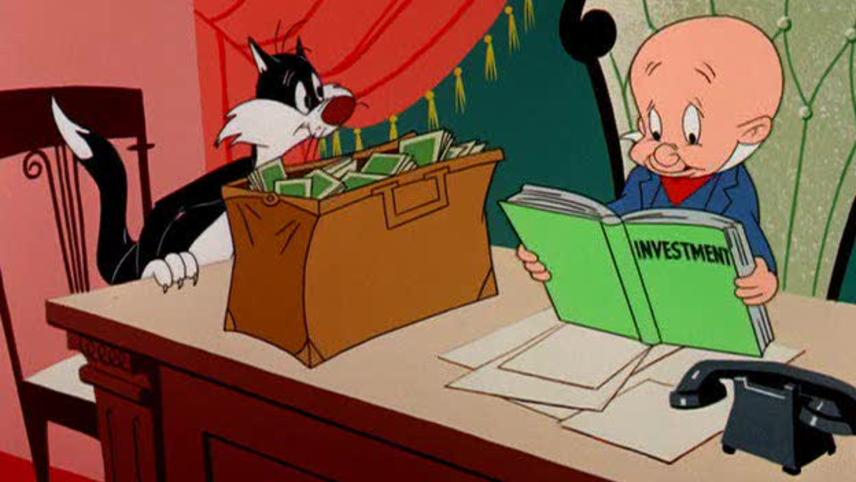
"Heir Conditioned" was one of three Warner Brothers shorts commissioned around 1955 by the Alfred P. Sloane Foundation to teach children about capitalism in the midst of the Cold War. This cartoon features some opportunistic trash cats eager to share Sylvester's newly inherited wealth. His economic advisor, Elmer Fudd, warns him against altruism and urges him to invest. After an unfun and didactic lesson, the trash cats get Stockholm Syndrome and refuse to accept Sylvester's handouts.

This set was rounded out with "Norman Normal," a bizarre late-period Warner Brothers' short of psychedelic nightmare capitalism. This existential tale of a salesman urged by his boss to take advantage of his client's drunken weakness at a kooky cinematic party doesn't seem to have been picked up as a recurring series. Perhaps 1968 TV execs passed on it due to confusion about the target demographic for animated psychological investigations.

Confusion about a cartoon's target audience was a theme which extended across the afternoon's offerings, most notably including "Po-Po-Tan," Bethy Squires' submission for this month's CRL.
This cartoon starts simply enough, when a young boy runs face first into a large pair of naked breasts.
Anime Review explains: "Beautiful sisters Ai, Mai, Mii, their android maid Mea and slippery pet ferret Unagi make an amazing journey together through time and space without ever leaving their beloved mansion behind! Following the clues of the strange dandelion-like “Popotan,” the girls are theoretically seeking the person who has the answers to their most personal questions, but they seem to have more than enough time to take side trips, meet new friends, visit hot springs and occasionally operate the X-mas shop they keep in the house along the way!"


The adult nature (upskirts, soft focus tits) of PoPoTan did seem to clash with the shrill child voices and sentimentality of the storyline.
"How am I supposed to jerk off to this?" posited Squires.

Few answers, more questions at this month's CRL.
Bring your theories and more topics for investigation to the table next time on Saturday, July 18 at 11AM at General Public Collective.
https://www.facebook.com/events/601278900014410/


Tuesday, April 7, 2015

Cartoon Research Laboratory

Winter was a time for tea and contemplation of the nuances of anime.
Now it's Spring. Birds are chirping, bears are bumping butts, and big dogs are bonking little dogs on the head with meaty fists. It's duck season! It's rabbit season! It's Research Season.


Cartoon Research Laboratory is an opportunity to consider the themes and tropes of "classic cartoons" alongside recent animation that has absorbed their influence.
April's theme was "Night in the Store."


Cartoon Research Lab is also an opportunity to enjoy Surrealist breakfast food and lots of coffee amongst other scholars of the medium.

(one scholar with his deviled quail eggs, "Little Devils")


(one serious academic)


Sunday, December 23, 2012

Apocalypse Party

I wanted to get cornered at Friday night's party so I sidled up to the girl in the hat who said she was an "oversharer." I said "Tell me all your problems, spare me no details." Delineate the intricacies of your OK Cupid profile. I would have loved to listen to that kid explicate the plot of Red Dawn all night, in real time, give me a grueling play by play. I just felt desperate not to indulge myself in interiority.

There were still solo minutes spent staring at a blackened hog's head. I touched its eyelid. It was rock hard and crispy. Punks in pelts and fur hats with markered knuckles farting around a tiny fire, pumping the keg in the garage. Hesher guys with doofus glasses crouching around the coffee table. Staring at the wet black floor, at the couple making out against the wall, in the kitchen a guy slurping a long loose noodle of meat. "Dude, let's Lady-and-the-Tramp that!" Earlier the boy I was kissing with rolled off the floor mattress to go to Food Not Bombs so I was already feeling awkward.

What did that hatted girl mean? "Oversharing's" the only thing that's interesting, the only thing worth doing, making misery malleable, transforming Abjection into content, turning anger inside out. It's all adding up: Glob as an unfixed, messy mass, abjection as radical subject matter, writing the body. Everything I've read lately has discussed and/or colluded with this point: Kate Zambreno's "Heroines," Megan Milks' essay in Mildred Pierce #4 on Dodie Bellamy, Barf Manifesto, and the Bulimic text, Lies journal, "Zippermouth," "Domain Errors: Cyberfeminist Practices."

I wrote my outline for my Glob talk ("Fake Danger") last night and it looks totally insane.


If you want a tightly organized essay on T.S. Eliot's use of Greek mythical symbolism in the Waste Land, click here to unsubscribe.

Sunday, November 25, 2012

Liquid Compass (WIP)


My joke at work is to stonily insist that I not be addressed with metaphors.

Only staggering literality for me, thank you! I've already asked you once nicely.

But in actuality I can't ignore certain symbols.

The last time he and I hang out is near the causey way at Lake Monroe, while exploring an abandoned waterslide; in a liquid, transitional space, now choked with foliage. That day, we trip through the woods, examining the remains of the Zoom Flume. I slip down the fiberglass incline and land with my boots planted in a leaf-clogged depository.

We wander around a now-rotted geodesic dome home overlooking the lake, festooned with shitty spraypaint. It's another unabashed bummer symbol, this broken utopian structure, bleakly scrawled with Juggalo bon mots. In a somewhat accusatory tone, he asks me How's my eyesight? How bout my internal compass? And has this been an average week for me?

He's referring to heavy drinking in Halloween costumes. This after I'd escorted him through his first drunken hook-up. Am I tugging this kid down a mucky ravine?

It is a relief, in a way, that he is leaving, before he finds out that I am not always nice. He's already learned today that I can not climb a tree. This hasn't been an average week; I haven't picked up a pen. I want to draw with people, to strike a balance between art making and social, to channel a solid engagement with something bigger and longer than myself. But part of me is required to court oblivion, occasionally in costume. Part of me invites in the unwelcome guest, the liquid variable, the destabilizing factor to flood where boredom might root.


(Work in progress, possibly to appear as a longer piece in the print edition of Glob, my anti-blog, forthcoming in early 2013.)

Monday, September 24, 2012

Lately Trending: Wrong Number Texts

Texts recieved in the last week:
1. A love declaration from Lori. -"Darling I love and adore you!" Shortly followed by: -"Sorry Erin, that was for J, in response to an I love you text." (This one just made me lonely.)

2. A tattooed booty pic from god-only-knows.

(This was followed mornings later by a slough of ambiguous images from the same unknown source, which got me into a spooky headspace. That day I rounded the corner to the coffee shop and confronted a pair of adult-sized mannequins hanging from the from the fire station balcony. Harnessed (harmless), with the fire fighters below recieving instruction. It was all so eerie I nearly urinated.)

3. Condolences on the life of Bitty and skull thanx:
-"Oh erin. this skull talks to me. Thank you so much."
-Me: (in response) "Maybe it's a different Erin's skull?"
-"And thank you for including me in the life and passing of little bitty, i bet she was amazing. i'll make you something beautiful so you can always carry her physically as well as in memory."

Franklin Rosemont described wrong numbers as surrealist poetry. In a post-landline world, wrong number texts continue to break through the veil, seeding their language of illogic onto my thoughts.

Tuesday, April 5, 2011

Animal Charm

Chicago's Animal Charm thought about some things I've been thinking about lately but..you know..a decade and a half ago.